Other Research Results
I’ve lost count of the exact number of observational and biomarker research studies that I have participated in since 2013. I think it is really important that participants receive individual results back as much as possible. Many of us are naturally curious, and offering individual information back to participants in studies is one way to increase engagement and express appreciation. However, results for even clinically available testing performed in a research setting are currently very rarely returned.
Below are images of a few relevant individual results/information I have received from research studies or from clinical practice. I find all of this information very interesting and personally valuable.
My son and I participated in our first research study at the National Institute of Health (NIH) clincal research hospital campus in Bethesda, MD in 2024. I was very pleased that I received results back from some of the tests. For example, I have taken the UPSIT many, many times before and never knew my score. But, I suspected I might have an issue after I had COVID-19. It took months for my smell to return and even now, some smells are totally different than before. Over three years later, and I know my sense of smell is not as strong as it used to be. My score is 31/40. As a 47 year old female, that is approx. 10th percentile or less. The result says “mildly impaired” but I think that is probably not taking into account my younger age.
PET scans taken at the University of British Columbia in Vancouver, Canada in 2014 (I was 37 years old at the time):

Dopamine

Serotonin

Neuroinflammation

Acetylcholine
Below are results from a gastrointestinal study I completed in June 2016 and July 2016 for LRRK2 G2019S carriers at the Parkinson’s Institute in Sunnyvale, CA. Tests included the SmartPill (gut transit times), an esophageal manometry and anorectal manometry. I had abnormal results.


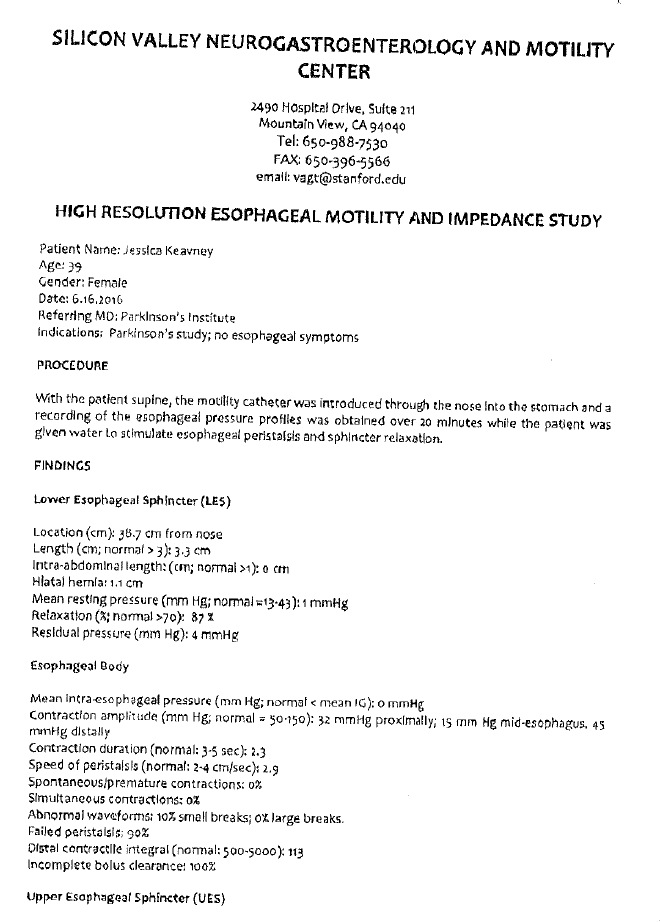
And this one is from June 2016, also abnormal


Ubiome study looking at gut microbiome; higher number of out of range organisms for IBS, IBD and Crohn’s seems to suggest to me that I may have evidence of gut inflammation


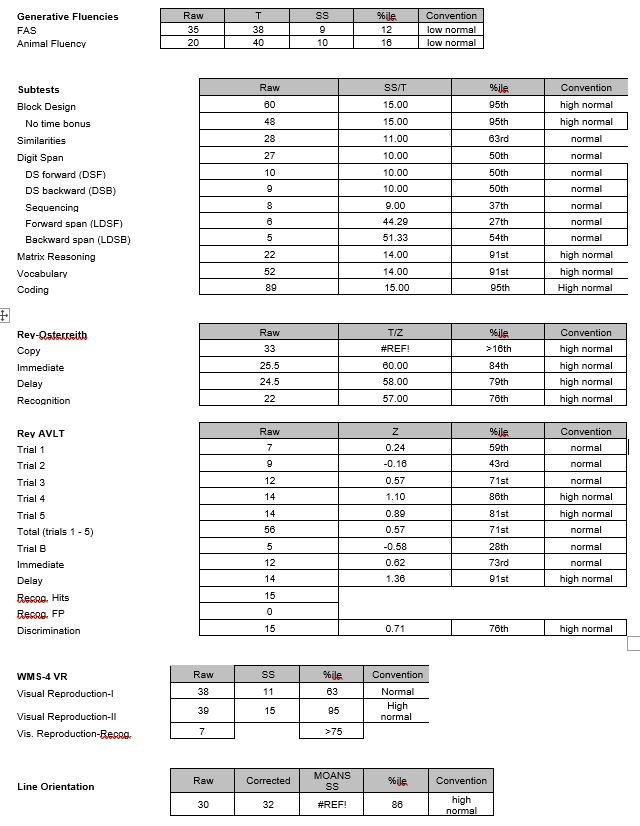
I participated in 3 hours of cognitive testing as part of a research study at Emory in 2023. I was included as a healthy control. This is the same cognitive testing that is done when evaluating patients for DBS surgery in the clinic. They do not usually return results to participants in the research study but I asked my neurologist for the results since I wanted a baseline for my clinical chart. I’m glad they agreed. Growing up, I was in gifted classes at school. We moved around a lot in my early school years, and sometimes I would just miss the cut-off depending on which state I lived in at the time. I test somewhere on the border of giftedness - more above average/bright than gifted. All three of my sons were tested into the gifted program at school too. Two of my sons are twice exceptional, meaning they are simultaneously gifted in some areas and have learning disabilities in other areas so their scores show up on far opposite ends of the bell curve. I believe my dad was gifted - we just didn’t have test results to show it. I believe that can complicate interpretation when you only test someone after they have been living with Parkinson’s for many years. My dad had cognitive testing completed as part of his evaluation for DBS at Emory. I don’t have the actual score sheet, but they said he had mild cognitive impairment. As a family, we noticed larger drops in my dad’s cognitive functioning than the testing showed, so I wish we had a baseline for comparison. My dad’s pathology on autopsy was very severe, indicative of Parkinson’s Disease Dementia (PDD). For me, I have noticed subtle changes in my attention and focus and I believe my working memory is not as strong as it used to be. My working memory scores on my recent cognitive testing are around 50th percentile - so perfectly normal. I’m just not sure if that is a material drop from what they would have shown 10 years ago.